Overview
Acknowledging our starting line, we researched a diverse array of best-in-class companies to spark inspiration for our future Mars portfolio of products & services by casting a wide net on ecosystem drivers. These best-in-class examples of forward-thinking actions related to sustainable nutrition and wellbeing – regardless of industry – deepen our understanding of the landscape.
You can view and filter all individual company activities collected by clicking on the themes listed on the bottom of this page.
Our Approach
- 10 total companies were researched in August and September 2021 using publicly-available data.
- The selected companies represented both food and non-food companies and included fast-moving consumer goods companies, retailers, a conglomerate manufacturer and a technology company.







- We focused on understanding activity across the food ecosystem evolving landscape: United Nations Food Systems Summit (UNFSS) Solution Clusters, the European Union Farm to Fork Strategy, and the IDEO Food Systems Game Changers Lab Solution Cohorts as each was evidence-based, expert-led and widely utilized, and aligned with our ‘future back’ approach.
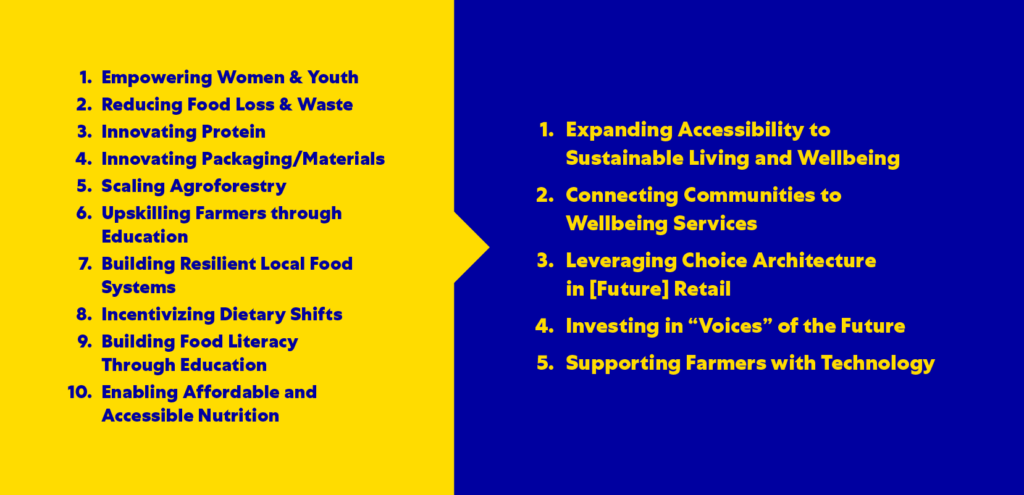
- From this pool of themes, we prioritized the 10 themes below given Mars’ reinvention goals and our wellbeing ambition.
- Then we mapped relevant company activities against each of the 10 original themes, which organically evolved into new areas of opportunity Mars could explore in its Manifesto journey, as outlined in our learning #2 below.
Our Learnings
1: Where we need to focus – Sustainable Nutrition. There is clear evidence that the Mars human food portfolio can evolve to effect true long-term change in sustainable nutrition.
- What we found:
- There are universal investment priorities across all companies: Empowering Women & Youth, Building Resilient Food Systems, Incentivizing Dietary Shifts, and Enabling Accessible Nutrition / Sustainable Living.
- 5 out of 5 large food company players have also prioritized investments to upskill farmers through education.
- 4 out of 5 non-food companies reviewed are invested in efforts around innovating sustainable packaging and materials.
- What it means for Mars: While all 10 thematic areas are relevant for Mars, it’s critical to explore areas of action where Mars has a license to play. In light of our human food portfolio and the categories we operate within today (food and confections), prioritizing sustainable nutrition activities in the following thematic areas will be essential for building credibility, according to a sense check through Key Opinion Leader interviews: Incentivizing Dietary Shifts, Enabling Accessible Nutrition / Sustainable Living , Reducing Food Loss and Waste, and Upskilling Farmers.
As part of Thriving people and our Cocoa sustainability programs embedded in our SiG (Sustainable in a Generation) Plan, Mars already invests in upskilling farmers. Therefore, we are focusing on the other four, sustainable nutrition-focused areas for where Mars can engage at a deeper level and drive greater positive impact.
2: How we differentiate ourselves. Tackling critical thematic areas with fresh tools will unveil novel areas for action and differentiate Mars’ approach to wellbeing from competitors and other leading companies.
- What we found: Not surprisingly, all companies are engaged in table stakes efforts that “check the box” on sustainability initiatives (e.g., zero waste initiatives, supporting fair supply chains, implementing sustainable packaging, focusing on water usage, etc.). To differentiate ourselves, we must go further to lead across any of these thematic areas identifying how we want to externally communicate and position ourselves within that. To lead within food systems as an inspired change agent, we looked to the non-food companies we benchmarked as not only inspiration for ‘what’ we could do, but also as possible collaboration partners for novel solutions.
- What it means for Mars: The white space opportunity is in pairing key thematic areas related to the SDGs (e.g. Sustainable Living) with a new tool or angle (i.e. access expansion) to create a novel approach to driving impact. With that lens, we evolved and translated the original ten themes into the following five synergistic thematic areas that illuminate fresh opportunity spaces and go beyond where other companies have taken action:
- Leveraging Choice Architecture in [Future] Retail:While behavioral economics principles alone aren’t novel in our current landscape, being laser focused on evidence-based “nudge” principles that can drive lasting, health-supporting behavior change in retail, is. From data-driven, personalized retail experiences to leveraging the cognitive bias that consumers experience when co-creating with a brand, how Mars presents its products and services to its consumers matters.
- Expanding Accessibility to Sustainable Living & Wellbeing: Sustainable living and wellbeing is already within reach for the well-resourced consumer; the opportunity is in expanding access to enable more consumers to live sustainably. Just as IKEA aims to democratize design, Mars aims to democratize wellbeing. From partnering with entrepreneurial brands to scale existing solutions to the masses, offering services that increase access to sustainable nutrition and wellbeing, or leveraging existing brand platforms to make it easier and more economical to practice wellbeing, brands are supporting customers in brand new ways.
- Investing in the “Voices” of the Future: The Mars’ customer of tomorrow is today’s youth. To empower and set up youth to succeed in their future, brands are A) investing in programs, services, and products that address the physical and environmental wellbeing challenges that today’s youth face (e.g., obesity, malnutrition, food illiteracy, food insecurity, mental illness, physical inactivity, environmental irresponsibility, etc.), as well as B) paving the way for equitable apprenticeships and internships that can create career-changing opportunities for youth and increase workforce diversity in underrepresented industries.
- Connecting Communities to Wellbeing Services: At every point in the food system – from the farmer to distributor to food processor to marketer to retail customer – there’s an opportunity to explore the delivery of targeted wellbeing services. Such services should support healthier agricultural communities, workplaces and families, and connect these stakeholders and like-minded communities to each other in the spirit of fostering social wellbeing.
3: How we can execute well. Sustainable nutrition and wellbeing initiatives must be proactively pursued, and they must leverage partnerships and regionality when appropriate. Mars needs to look at an ecosystem of wellbeing offerings, much like some of the companies reviewed do today.
- What we found: Several companies made early and iterative moves to drive societal impact, showcasing their proactivity in addressing challenging realities.
- Through Core Business Activities: By and large, roughly 83% of actions were conducted out of the company’s core business activities, with only five examples executed out of a company’s philanthropic or foundation arm.
- Through tailoring to community: Of the company actions identified and reviewed against the evolved four priority themes, roughly 60% were global in nature and 40% were regional efforts (U.S., China, and India markets represented all regional efforts due to the nature of the companies selected for the review).
- Through Partnerships: From NGOs to key opinion leaders to youth – companies have co-created with experts to create systemic solutions. These efforts doubled to further reputation building and transparency.
- What it means for Mars: Exploring a measured mix of bold actions executed in partnership with credible players and regional stakeholders can spur innovative business models, support Mars’ growth in regional markets and drive impact. Regional efforts must identify, recognize and address the unique and most pressing needs of those markets, in lock step with stakeholders in those regions. These efforts can include championing traditional and native foods and ingredients that can make an impact on local families, their livelihoods, and agricultural sustainability. Ensuring these activities stem directly from the relevant business segment (versus its philanthropic arm) can ensure the company meets its objective to grow its market presence.